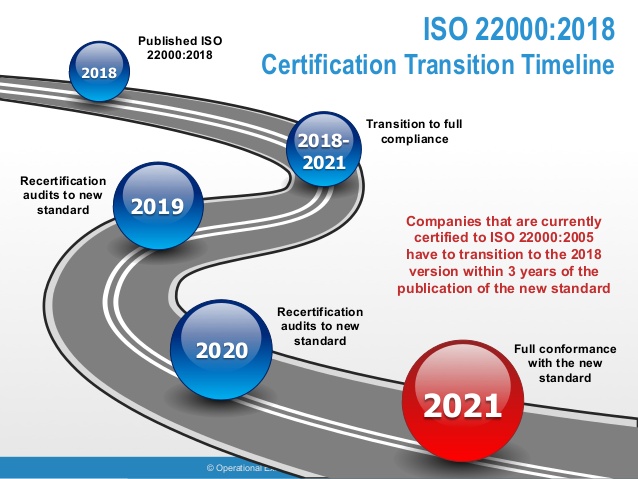
Context of the organization is a new requirement in ISO 22000, this section requires the organization to analyses its context, determine its interested parties, define the scope of the food safety management system, and a clear focus on the processes and requirements needed to achieve the food safety objectives.
In the ISO 22000:2018 standard, the context of the organization is outlined as;
4.1 – Understanding the organization and its context
4.2 – Understanding the needs and expectations of interested parties
4.3 – Determine the scope of the food safety management system
4.4 – Food safety management system
First the organization has to decide “what is it that your company does”. (Ex: manufacturing of wheat based bakery products and the distribution of them)
Defining this helps to understand how will achieve that and what road-blocks and opportunities you face.
Where to start?
4.1 – Understanding the organization and its context;
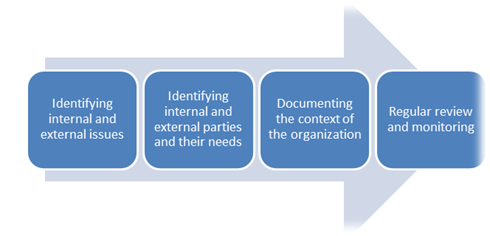
An organization will need to consider both the internal and external issues and the needs and expectations of stakeholders and interested parties. In this case “issue” can include positive and negative factors or conditions for consideration.
Although the standard doesn’t prescribe the method for determining the context of the organization, there are some logical steps and milestones.
Context of the organization also looks at a SWOT, PESTLE or CPM (Competitive Profile Matrix) analysis;
SWOT is to identify internal strengths, internal weaknesses, external opportunities, and external threats. As well as mitigation of the risk and the company’s plans to invest in the internal strengths and opportunities.
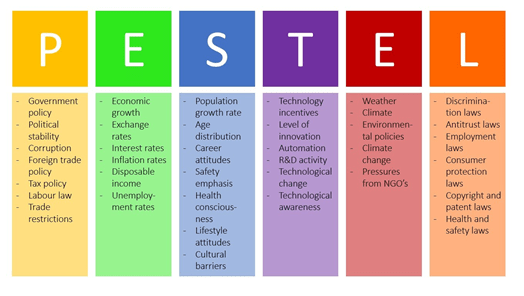
PESTEL model involves the collection and portrayal of information about external factors which have, or may have, an impact on business.
PESTEL stands for:
- P – Political
- E – Economic
- S – Social
- T – Technological
- E – Environmental
- L – Legal
Even though documented information is not mandatory, it is useful to demonstrate the understanding & analysis of the internal & external issues;
External Issues;
- Cultural, social, political, legal, financial, technological, economic and natural surroundings including the environment in which the organization operates.
- Who the competitors are and any contractors, subcontractors, suppliers, partners and providers.
- National & international law (Environment, employment, health and safety)
- Industry drivers and trends which have influence on the organization
- The organization products and services and their influence on food safety
- Availability and variety of external providers 0f services/products
- Capacity of changes regarding premises
- Waste management
- Trade controls
- Tax policies / exchange rates
Internal Issues;
- Governance, organizational structure, roles and accountabilities
- Policies, objectives and the strategies in place to achieve them
- Competence of personnel
- Food safety culture within the organization and the relationship with workers’
- Process for the introduction of new products, materials, services, tools, software, premises and equipment
- Working conditions
- Resources
- Retention of skilled employees
- Number and variety of customers
- Infrastructure level
- Rate of technological change
- Spending on research & development
- Communication infrastructure
- Access to newest technology
An organization’s internal context is the environment in which it aims to achieve its objectives. Internal context can include its approach to governance, its contractual relationships with customers, and its interested parties. Things that need to be considered are related to the culture, beliefs, values, or principles inside the organization, as well as complexity of processes and organizational structure.
4.2 – Understanding the needs and expectations of interested parties
This includes mapping interested parties; stakeholders, and others that may be perceived to be affected by your company (e.g. suppliers, FDA, employees, etc.)
Stakeholders can influence FSMS positively and negatively.
It is necessary to identify all stakeholders within the FSMS, they will; shareholders, suppliers, competitors, consumers, trade associations, employees, customers, distributors, regulators, landlords.
The organization need to identify needs and expectations of those parties which are related to FSMS. Some of the needs and expectations would be mandatory and incorporated into law and regulatory requirements. Therefor the organization should identify, review and update information related to the interested parties and their requirements.
4.3 – Determine the scope of the food safety management system
This is not a new clause, but there are some extended terms with considering organization context and needs and expectations of interested parties.
The scope statement must be maintained as documented information. For example:
“The pasteurization, carbonation and packing of fruit juice into glass bottles”
4.4 – Food safety management system
This is same as the 4.1 clause in the ISO 22000:2015 standard, an organization has to establish, implement, maintain and continually improve a FSMS.
 Food Desk